Everyone knows how to save for vacation in theory: spend less than you earn, put the difference aside. In practice, the vacation fund is the first thing raided for car repairs and the last thing funded after everything else. The difference between people who take the trip and people who talk about it is rarely income. It is a plan with a number, a date, and an automatic transfer.
This is that plan. You will price the trip, divide it into a monthly number, give it its own account, automate the transfer, and free up the cash with three specific cuts backed by real math. No second job required.
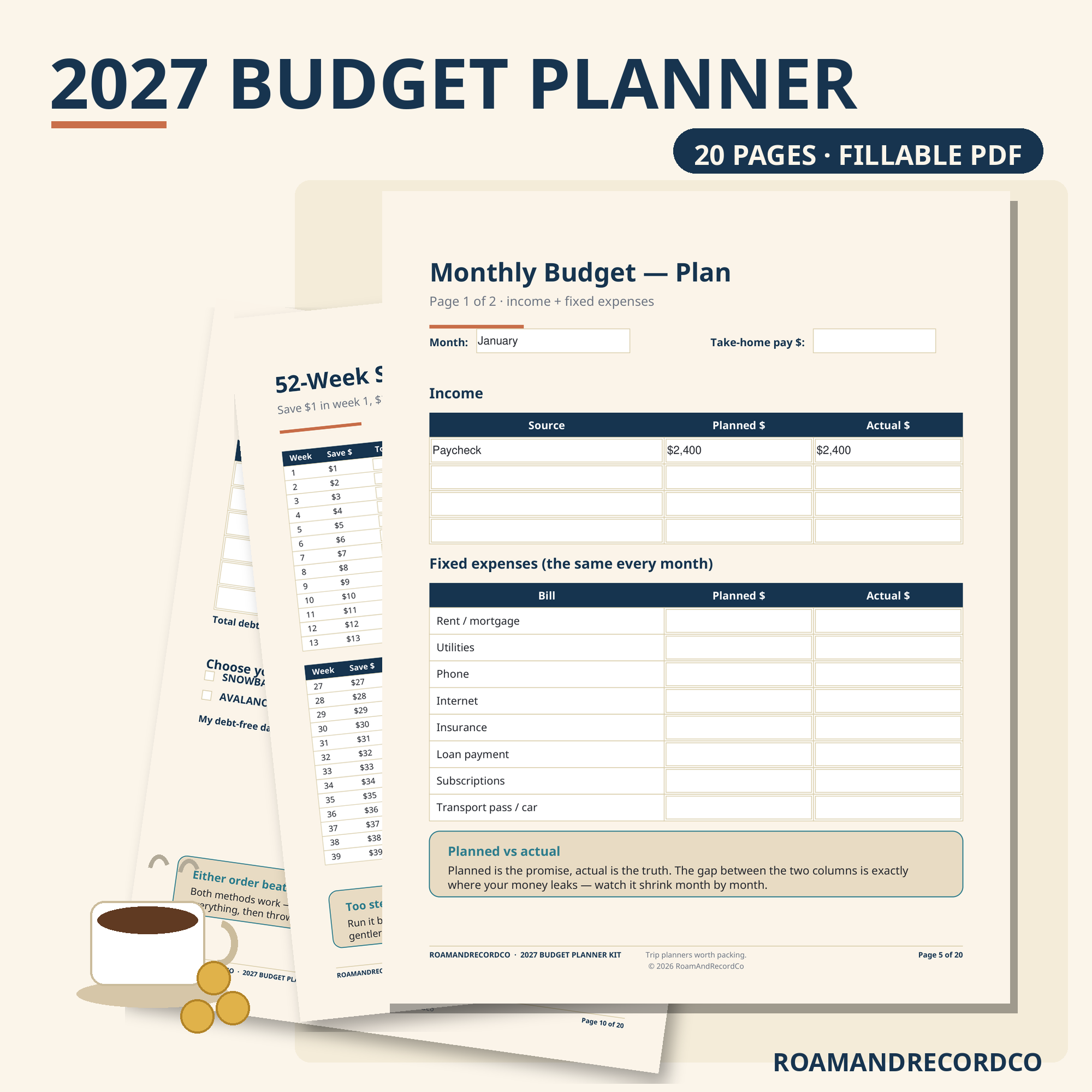
2027 Budget Planner
Fillable PDF · Instant download · US Letter + A4 · No app needed.
Step 1: Reverse-Engineer the Goal
Start from the trip, not from your paycheck. Price the trip first using a real budget: flights, lodging, food per day, activities, local transport, souvenirs, and a 10 percent buffer. Suppose the honest total is $2,400. Now divide by the months until departure:
- 12 months out: $200 per month.
- 8 months out: $300 per month.
- 6 months out: $400 per month.
Translate it into paycheck terms, because paychecks are when money actually moves. At $200 a month with biweekly pay, that is about $92 per paycheck. At $300 a month, about $138 per paycheck. The monthly number must be boring and automatic, not heroic. A heroic number survives three weeks; a boring number survives twelve months.
If the monthly number does not fit your life, change the trip before you change the math. A five-day trip becomes four days. A peak-season date becomes shoulder season. A far destination becomes a closer one you have never properly explored. Shrinking the trip to fit the savings plan is not settling; it is the reason the trip actually happens instead of living on a vision board for three years.
Step 2: Give It a Sinking Fund
A sinking fund is a separate savings account with exactly one job: this trip. Open one, name it after the destination and date, like Alaska July 2027, and let that name do psychological work every time you see the balance.
Separation is the entire mechanism. Money mixed with emergency savings gets spent on emergencies. Money sitting in checking gets spent on Tuesdays. Money in an account named for a trip gets spent on the trip, because raiding it requires confronting the name on the account. Most online banks let you open additional savings accounts in minutes with no fees and no minimums, so the setup cost is effectively zero.
Fund the account from the start even if the first transfer is small. A sinking fund with $92 in it is a real plan in motion; a plan to start saving next month is a wish. Momentum matters more than the opening amount.
Step 3: Automate the Transfer
Set the automatic transfer for the day after payday. Money you never see is money you never miss, and money that moves before discretionary spending never has to compete with it. If you are paid biweekly, split the monthly number across paychecks: $200 a month becomes $92 every other Friday, timed to land the morning after the paycheck.
Treat this transfer like a bill, not a leftover. Bills get paid first and nobody negotiates with the electric company about whether this month feels tight. Your vacation fund gets the same status. If a month is genuinely tight, reduce the transfer rather than skipping it; a $40 transfer keeps the habit alive, and the habit is what carries the other eleven months.
Log the transfer in the 2027 Budget Planner each month. The sinking fund gets its own line, so you watch the balance climb toward the trip total in writing instead of hoping it is growing somewhere. Visible progress is a powerful motivator in month seven when the novelty has worn off.
Step 4: Cut Three Expenses With Real Math
You do not need to overhaul your life. You need three specific cuts with the math shown, held for the months until departure. Here is a worked example:
Cut one: dining out. Four restaurant meals a month at $45 each is $180. Cook at home for two of those weeks instead, and you save $90 a month. Over twelve months, that is $1,080.
Cut two: subscriptions. Audit every recurring charge: streaming services, apps, memberships, subscription boxes. Cancel two at $16 a month each. That is $32 a month, or $384 a year, for services you will not miss by February.
Cut three: the coffee shop run. At $5.50 a cup across 20 workdays, that is $110 a month. Brew at home three days a week and keep the coffee shop for two. You save roughly $66 a month, about $792 a year, and you still get your Friday latte.
Add them up: $90 + $32 + $66 = $188 a month, or about $2,256 a year. That is nearly the entire $2,400 trip funded by three cuts, none of which requires suffering. Note the framing that makes this sustainable: these cuts fund the trip, not forever. Anyone can cook two extra dinners a week for eight months when the payoff is a named destination with a date.
Your 12-Month Savings Timeline
Twelve months out: price the trip honestly, open the sinking fund, and set the automatic transfer. Write the trip total and the monthly number where you will see them.
Nine months out: book the flights, which is often the best window for domestic fares. The fund should hold roughly 25 percent of the trip total. Pay for flights from the fund, not from credit.
Six months out: the halfway checkpoint. The balance should sit near 50 percent of the trip total. Behind? Sharpen one of the three cuts or trim the trip scope now, while there is still time for small corrections to compound.
Three months out: book lodging and pre-book the big activities. Roughly 75 percent should be saved. The remaining monthly transfers cover the last quarter plus the buffer.
One month out: the fund hits 100 percent. Pay any remaining bookings from the fund. Confirm the buffer is intact and separate from spending money.
Departure week: the buffer stays in the fund for on-trip surprises. What is unspent becomes the seed of the next trip's sinking fund, which you open the week you get home while the motivation is fresh.
Protect the Fund
Two rules keep the fund alive through a full year. First, the fund pays for the trip and nothing else. Car repairs, medical bills, and home emergencies come from the emergency fund, which is a separate account with its own job. If you do not have an emergency fund yet, build a small one of $500 to $1,000 before or alongside the vacation fund, because the emergency will happen either way and it is better if it does not eat the trip.
Second, the windfall rule: half of any unexpected money, a bonus, a tax refund, a cash gift, goes straight to the fund. The other half is yours to enjoy however you want. This rule turns luck into progress without turning you into a miser.
If you must raid the fund, do it with paperwork: write down the amount, the reason, and the repay-by date, and treat the repayment like the original transfer, automatic and non-negotiable. A documented raid with a repayment plan is a detour. An undocumented raid is the end of the trip.
Frequently Asked Questions
How much should I save each month for vacation?
What is a sinking fund?
Should my vacation fund be a separate bank account?
What if an emergency wipes out my vacation fund?
2027 Budget Planner
Fillable PDF · Instant download · US Letter + A4 · No app needed.