A new year is the only moment when your money gets a clean page: twelve empty months, no spending yet, every dollar unassigned. Most people waste it. January fills up with the same habits as December, and by March the fresh start is a memory. Travelers feel it hardest, because trips are the first thing cut when money is vague and the last thing funded when money is tight.
This guide sets up your 2027 budget so travel is not a leftover. It becomes a line item with a monthly amount, a savings target, and a thirty-minute monthly check-in that keeps it alive all year.
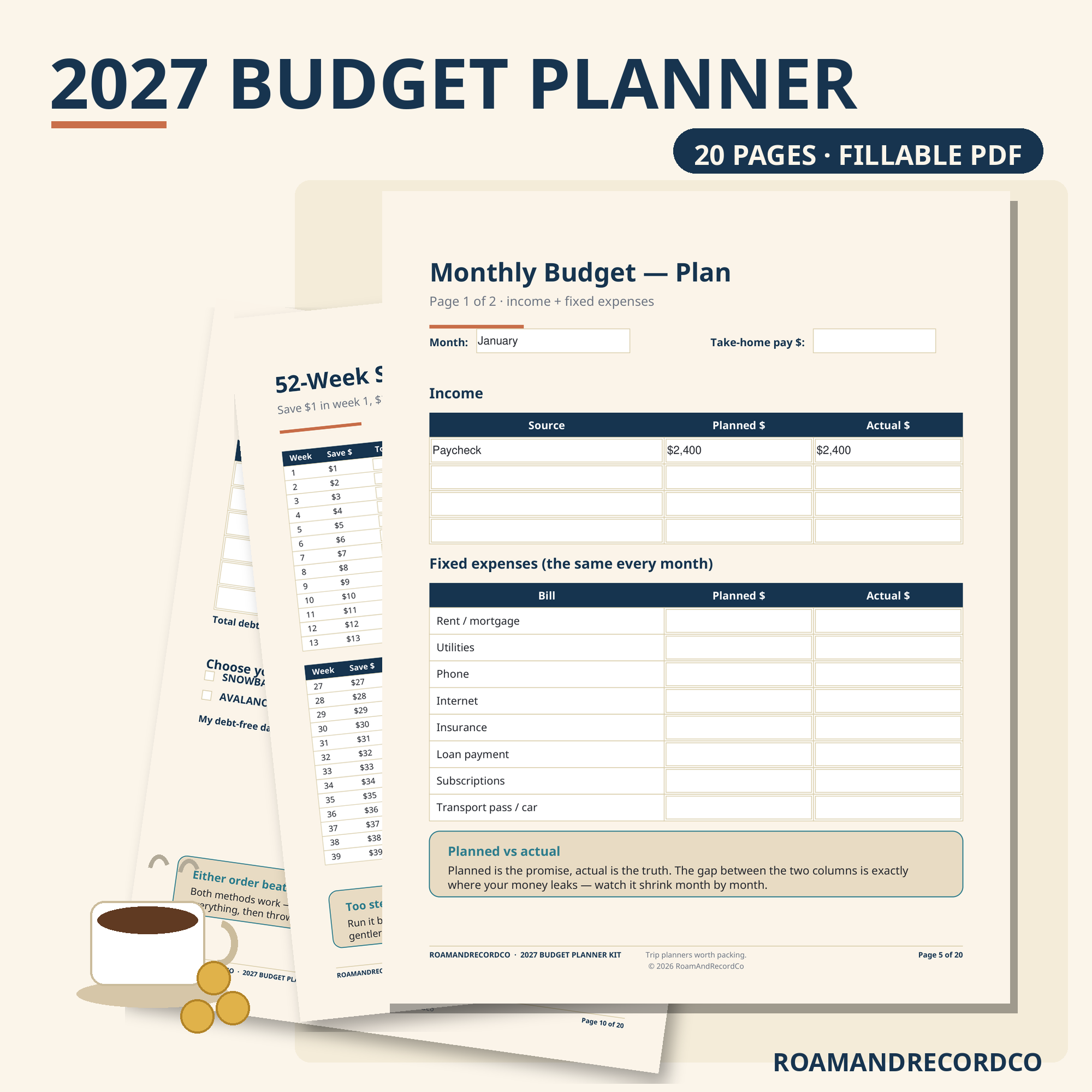
2027 Budget Planner
Fillable PDF · Instant download · US Letter + A4 · No app needed.
Start With Last Year's Numbers
A budget built on guesses collapses by February. Pull three months of bank and credit card statements, October through December 2026, and categorize every expense into six buckets: housing, transport, food, insurance, debt payments, and personal spending. Average each bucket across the three months. That average is your baseline, which is not your budget yet, but it is the truth your budget has to work with.
Pay attention to the surprises, because there are always two or three. The subscriptions you forgot you had. The food total that is a fifth higher than your guess. The personal spending bucket that quietly doubled in December. Write the surprises down; they are the raw material for the decisions in the next section. A budget that ignores last year's actual behavior is a fantasy document, and fantasy documents do not survive contact with January.
Build the Annual Budget, Month by Month
Zero-based budgeting means every dollar of take-home pay gets a job before the month starts. Here is a sample monthly budget on $4,500 of take-home pay:
| Category | Monthly amount |
|---|---|
| Housing (rent or mortgage, utilities) | $1,500 |
| Food (groceries plus dining out) | $600 |
| Transport (car payment, gas, insurance, transit) | $450 |
| Insurance (health, renters, other premiums) | $300 |
| Debt payments | $250 |
| Emergency savings | $400 |
| Travel fund | $300 |
| Personal and fun | $200 |
| Buffer (irregular bills, surprises) | $200 |
| Remaining to extra savings | $300 |
Check the math: the categories sum to $4,200, leaving $300 unassigned, which goes to extra savings. Every dollar has a job, including the buffer row, which exists because irregular bills like car insurance and annual subscriptions ambush monthly budgets that pretend every month is identical.
Annualize the lines that matter. The travel fund at $300 a month is $3,600 of trip money in 2027. Emergency savings at $400 a month is $4,800 toward a full emergency fund. Annual numbers turn abstract monthly discipline into concrete outcomes, which is what keeps the system running in August when the novelty is gone. Copy this table, replace the numbers with your own baseline from the previous section, and you have a working 2027 budget in under an hour.
Give Travel Its Own Line Item
Here is the rule that changes everything for travelers: travel gets its own budget line, funded monthly, at 5 to 10 percent of take-home pay. On $4,500 of take-home, that is $225 to $450 a month, or $2,700 to $5,400 a year of dedicated trip money. It is funded with the same seriousness as rent, because a line item that gets skipped is not a line item.
Split the travel fund into named sub-funds when you have specific trips in mind: a Japan fund with a $2,000 target, a Christmas flights fund with a $600 target. Named funds resist raiding far better than one generic pot, because moving money out of the Japan fund requires admitting the Japan trip just got smaller.
The 2027 Budget Planner is built for exactly this structure: twelve monthly spreads, a dedicated travel-fund tracker, and a year-at-a-glance page where the annual target stares back at you every month. The planner does not create the discipline; it gives the discipline a place to live where you cannot pretend it does not exist.
Debt Payoff vs. Travel: The Honest Trade-Off
Carrying high-interest debt while saving for travel is like filling a bucket with a hole in it, so here is the honest math. A $3,000 credit card balance at 24 percent APR costs roughly $720 a year in interest alone. That is a plane ticket burned annually for the privilege of owing money. Debt above roughly 15 percent APR should be paid down before discretionary travel gets funded, because no trip returns 24 percent.
Below that threshold, the hybrid approach works: split extra cash between debt and the travel fund. An extra $400 a month becomes $250 toward debt and $150 toward travel. You make real progress on both, and you do not spend two years with no trip to show for the sacrifice, which is how strict debt plans die.
Two non-negotiable rules. First, never fund a trip with new credit card debt; the interest turns a $2,000 trip into $2,400 or more, and you will still be paying for it when the tan fades. Second, pick a payoff method and stop switching: avalanche attacks the highest interest rate first and costs the least, snowball clears the smallest balance first and delivers the fastest psychological win. Either one beats the method-switching that restarts progress every quarter.
The Monthly Money Check-In
Thirty minutes, first weekend of every month, same pages every time. This is the review loop that keeps the annual budget alive:
- Record last month's actual spending in each category, from statements, not memory.
- Compare actuals to the budget and circle the two biggest overruns.
- Check emergency fund progress against the target of three months of essential expenses.
- Check the travel fund balance against where it should be: month number times the monthly target.
- Confirm this month's savings transfers moved, or move them manually right now.
- Scan for upcoming irregular bills: semiannual car insurance, annual subscriptions, quarterly taxes.
- Adjust next month's numbers for what you learned. The budget is allowed to change; it is not allowed to be ignored.
- Write one money goal for the month in a single sentence, such as bringing food spending under $550.
Run this twelve times and the budget stops being a January document and becomes a living system. The check-in is also where the travel fund gets defended: when the balance is on target in June, the December trip is already half-paid, and no amount of holiday temptation can argue with arithmetic.
When to Adjust the Plan
A budget is a plan, not a prison. Adjust on triggers, not on moods:
| Trigger | Action |
|---|---|
| Income changes up or down | Rebuild the budget within two weeks on the new number |
| Travel fund two months behind target | Trim personal spending or shrink the trip scope now |
| Emergency fund gets raided | Pause travel contributions until one month of expenses is rebuilt |
| Rent hike or major bill increase | Recalculate every percentage; something has to give |
| Windfall: bonus, refund, gift | Half to debt or savings, half to the travel fund or fun |
| Trip prices jump | Re-price the trip, extend the timeline, or pick a cheaper tier |
The pattern across every row: small corrections early beat large corrections late. A budget reviewed monthly needs tweaks. A budget reviewed never needs a rescue. Set the 2027 budget up in January, run the thirty-minute check-in every month, and travel stops being the thing you hope for and becomes the thing you funded.
Frequently Asked Questions
How much of my budget should go to travel?
Should I pay off debt before traveling?
How often should I review my budget?
What if my income is irregular?
2027 Budget Planner
Fillable PDF · Instant download · US Letter + A4 · No app needed.