Most trip budgets fail before the trip starts, because they were never really budgets. They were a flight price plus a vague hope. Then the hotel costs more than expected, food runs $70 a day, the rental car needs insurance, and the affordable long weekend lands on a credit card at punishing interest.
A travel budget planner approach flips the order: decide what the trip can cost before you decide where it goes. This guide gives you the framework, daily cost estimates by destination type, a method for tracking spending on the road, and a fully worked 5-day example you can copy line by line.
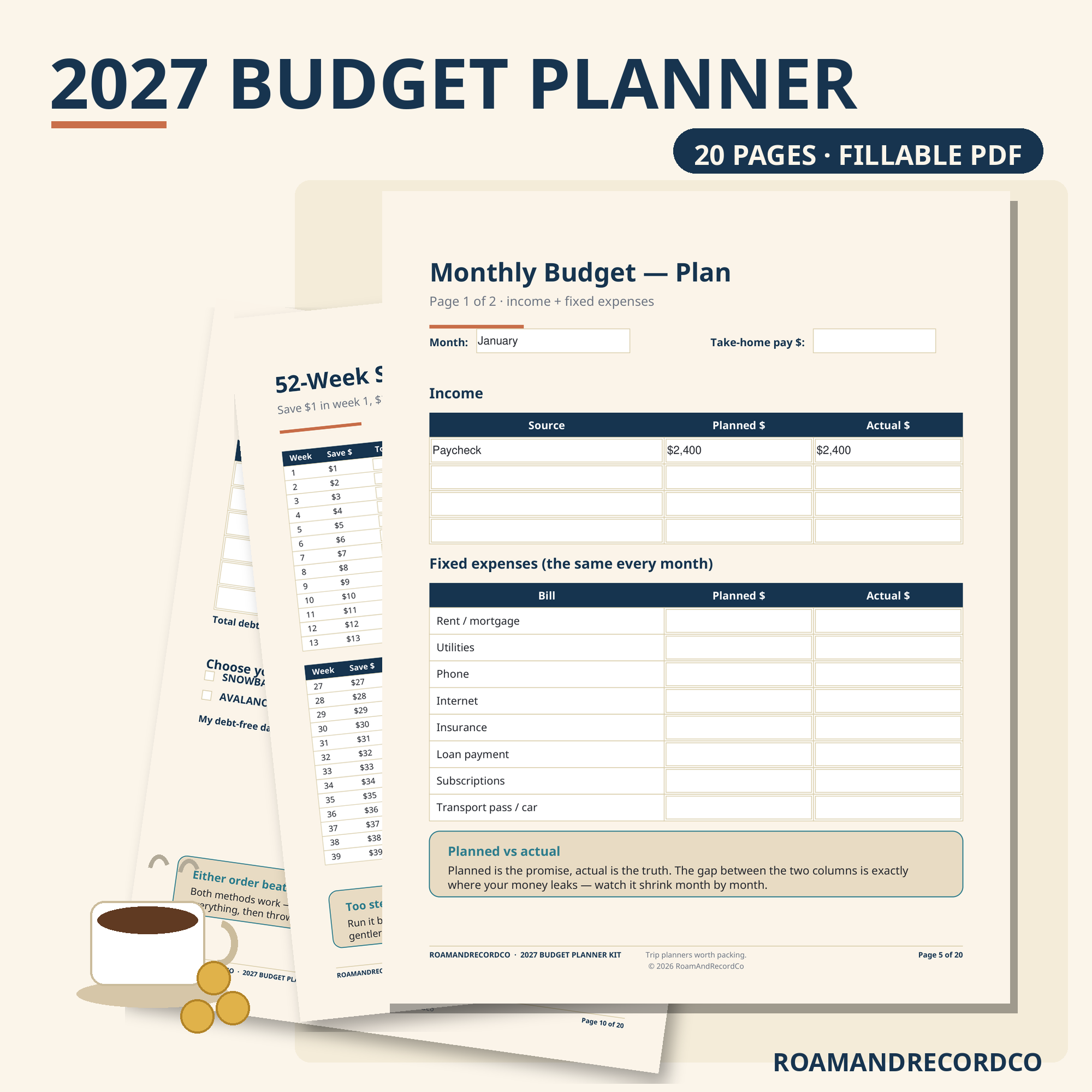
2027 Budget Planner
Fillable PDF · Instant download · US Letter + A4 · No app needed.
The Trip Budget Framework
Every trip, from a weekend road trip to a two-week vacation, breaks into the same six categories. Learn them once and every future trip gets easier:
- Transportation: flights, rental car, gas, tolls, parking, airport shuttles, and local transit. Include the fees people forget: checked bags, seat selection, rental car insurance or toll transponders.
- Lodging: hotel or vacation rental nightly rate plus taxes and fees. Resort fees run $25 to $45 per night at many US properties, and cleaning fees on rentals can add $100 or more per stay. Always price the all-in nightly cost, never the advertised rate.
- Food and drink: every meal, coffee, snacks, and drinks out. This is the category most people underestimate by the widest margin.
- Activities and tickets: theme parks, tours, museum entries, show tickets, national park passes. Price the must-dos in advance; they are often cheaper bought ahead.
- Shopping and souvenirs: set this as its own capped category or it will quietly absorb the buffer.
- Buffer: 10 to 15 percent of the subtotal, reserved for the unexpected. Non-negotiable.
Split the budget into fixed costs and variable costs. Fixed costs are booked before departure: flights, lodging, rental car, pre-bought tickets. Variable costs happen daily: food, local transport, spontaneous activities. The planning formula is simple: estimate variable costs per day, multiply by the number of days, add the fixed costs, then add the buffer. That total is the trip budget, and it gets decided before anything is booked.
Estimate Daily Costs by Destination Type
Daily variable costs depend heavily on where you go. Use this table as a planning starting point, priced for two travelers sharing a room at 2026 US prices. For safe planning, budget at the top of each range.
| Daily cost | Budget road-trip town | Mid-range US city | Major metro or resort |
|---|---|---|---|
| Lodging | $90-$130 | $140-$200 | $250-$400 |
| Food and drink | $40-$60 | $60-$90 | $90-$140 |
| Local transport | $15-$25 | $25-$45 | $40-$70 |
| Activities | $10-$30 | $30-$60 | $50-$100 |
| Daily total | $155-$245 | $255-$395 | $430-$710 |
A three-day weekend in a budget road-trip town lands around $465 to $735 in variable costs for two people, before getting there. The same long weekend in a major metro can run $1,290 to $2,130. Neither is better; the point is that the destination type sets the budget tier, and choosing the tier deliberately is what keeps a trip affordable.
Adjust for your travel style. One nice dinner out per trip moves food spending up a tier for that day. Free activities, hiking, beaches, free museum days, pull the activities row down sharply. Traveling solo removes the room-sharing savings but also removes the second person's food and ticket costs, so solo travelers often land near the couple's total anyway.
Track Spending on the Road
A budget you do not track is a wish. The method that actually survives a vacation is the five-minute nightly log: every evening, write down each expense with its category. Five minutes, phone notes app or a small notebook, done before bed. The daily total takes ten seconds to compare against your daily target, and that comparison is the entire control system.
For food, the category that sinks most budgets, use a daily cash envelope or a separate daily target. If the food target is $130 a day for two and Tuesday runs $170, Wednesday's target becomes $90. No guilt, just arithmetic. Couples and groups should keep one shared log rather than three private ones; settle up at the end of the trip from the single record instead of reconstructing Venmo chaos from memory.
Photograph receipts for the big expenses: lodging, rental car, activities. If a charge looks wrong later, the photo is your evidence. And set a mid-trip checkpoint: on day three of a five-day trip, add up spending so far. If you are 20 percent over the pro-rated target, you still have two days to correct. Discovering the overrun at home helps no one.
A Worked Example: 5 Days in a Mid-Range City
Here is the full framework applied to a five-day trip for two in a mid-range US city, using top-of-range daily estimates for safety:
| Item | Calculation | Cost |
|---|---|---|
| Round-trip flights | 2 x $320 | $640 |
| Hotel, 4 nights | 4 x $150 all-in | $600 |
| Food and drink | 5 days x $130 | $650 |
| Activities and tickets | Pre-booked tours + 2 museum days | $240 |
| Local transport | Airport transfers + 4 days transit | $120 |
| Souvenirs (capped) | Fixed cap, not a wish | $80 |
| Subtotal | $2,330 | |
| Buffer, 10% | 0.10 x $2,330 | $233 |
| Trip total | $2,563 |
Read the choices inside the numbers. The $150 hotel rate is all-in, meaning taxes and fees are already inside it. Food at $130 a day for two assumes one casual nice dinner, with the other meals kept modest. Activities are pre-booked, which usually beats gate prices. The souvenir line is a cap decided at home, which is the only way souvenirs stay at $80 instead of $200.
Copy this table for your own trip: swap in your destination's tier from the table above, your actual flight and hotel prices, and your trip length. The arithmetic takes fifteen minutes and replaces weeks of vague financial anxiety with a number.
The 10 to 15 Percent Buffer Rule
The buffer is not extra spending money. It is the fund for everything you cannot predict: the fare that rose between planning and booking, the restaurant you did not plan but should not skip, the pharmacy run, the checked-bag fee you forgot, the activity that costs more at the door. On a $2,563 trip, the $233 buffer absorbs two or three of these without touching the plan.
Size the buffer to the trip's uncertainty. A road trip to visit family, where lodging is free and plans are fixed, can run a 10 percent buffer. An international trip with connections, currency swings, and more unknowns deserves 15 percent. If the buffer goes unspent, it rolls into the next trip's fund. It never becomes permission to upgrade the last dinner, because next trip's budget starts the day this one ends.
Turn the Budget Into a Savings Target
A trip budget becomes real the moment it turns into a monthly number. Take the trip total, divide by the number of months until departure, and that is the monthly savings target: $2,563 over eight months is $321 a month, or about $148 per biweekly paycheck. If that number does not fit your life, change the trip before you change the math: fewer days, a cheaper tier, an off-season date.
That monthly number needs a home in your regular budget, which is where the 2027 Budget Planner comes in: the trip total becomes a line item, the monthly transfer gets tracked against it, and the buffer has its own row so it does not get quietly spent. A trip with a funded line item is a plan. A trip with a hope is a credit card balance. The difference between them is about fifteen minutes of arithmetic and a page that holds the numbers where you can see them.
Frequently Asked Questions
How much should I budget per day for a US trip?
Should I use cash or a credit card while traveling?
How do I track spending on a group trip?
How far ahead should I budget for a trip?
2027 Budget Planner
Fillable PDF · Instant download · US Letter + A4 · No app needed.