There is a moment on every first RV trip — usually about an hour after pickup, usually at a gas station — when the new driver looks at the 30 feet of vehicle behind them and thinks: what have I done? Then they pull back onto the highway, the house-on-wheels hums along at 60 miles per hour, and by dinner they are grilling outside their own front door in a national forest. That arc from terror to total convert takes about one day, provided you understand the basics first.
This guide covers what first-timers actually need: whether to rent or buy, the real differences between Class A, B, and C motorhomes, how hookups and dump stations work, where you can legally park overnight, and the driving skills that keep your first trip dent-free.
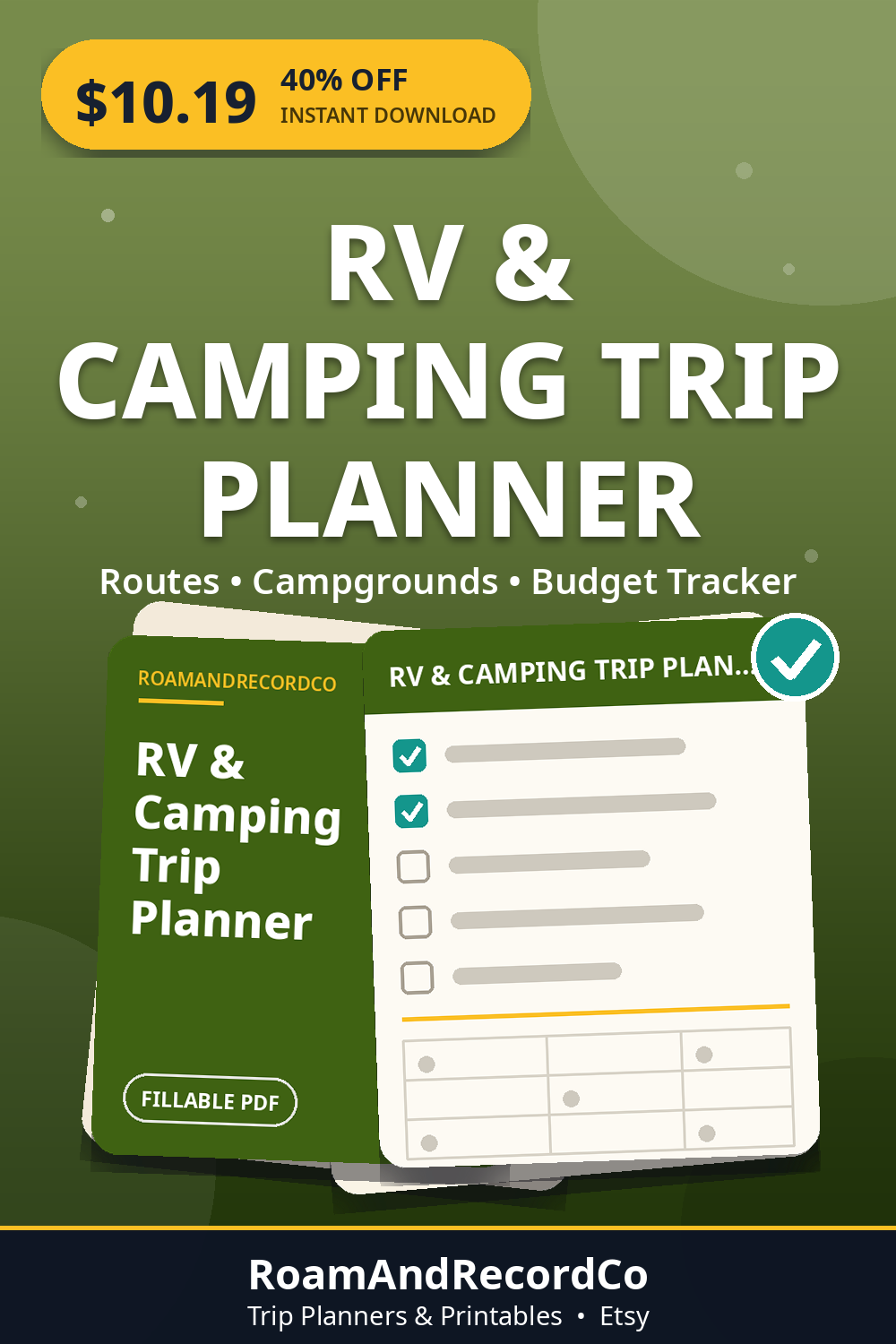
RV and Camping Trip Planner
Fillable PDF · Instant download · US Letter + A4 · No app needed.
Rent Before You Buy — Seriously
The single best advice for RV beginners is to rent first, ideally two or three times, before even browsing purchase listings. A week-long rental costs $1,000 to $2,000 depending on the rig and season — expensive as a vacation, but cheap as market research. You will discover things no brochure tells you: whether you actually like driving a 32-foot box, whether your partner can sleep with the generator hum, whether a wet bath (toilet inside the shower) is a dealbreaker.
Peer-to-peer rental platforms and traditional dealership fleets both offer Class C motorhomes, camper vans, and towable trailers. Book the size you think you want, then pay attention to what annoys you all week — that annoyance list becomes your buying criteria later. Many first-time buyers who skip this step discover within a year that they bought too big, too small, or the wrong layout entirely, and RVs depreciate fastest in that first year of ownership.
If you do buy, the used market is a beginner's friend: a well-maintained three-to-five-year-old Class C costs 30 to 40 percent less than new and has already had its factory defects fixed by the first owner. Always pay for an independent pre-purchase inspection ($300 to $500) — water damage, the number-one RV killer, hides behind pretty interiors.
Class A, B, and C: Explained Simply
Motorhomes come in three classes, and the differences matter more than the letters suggest:
| Class A | Class B | Class C | |
|---|---|---|---|
| What it is | Bus-style, flat front | Camper van on a van chassis | Truck cab with overhead bunk |
| Typical length | 30–45 ft | 18–24 ft | 22–32 ft |
| Sleeps | 4–8 | 2–4 | 4–8 |
| Drives like | A bus | A large SUV | A moving truck |
| Best for | Full-timers, big families | Couples, weekenders | Families, first-timers |
| New price range | $150,000–$400,000+ | $100,000–$200,000 | $80,000–$180,000 |
| Rental per night | $200–$350 | $150–$250 | $175–$300 |
For first-timers, Class C is the sweet spot: it sleeps a family, drives without a commercial feel, and the over-cab bunk gives kids a bedroom they will fight over. Class B vans are the easiest to drive and park — they fit in a normal parking space — but the living space is genuinely tight for more than two people. Class A rigs are rolling apartments with the price tags and driving demands to match; wonderful machines, terrible first RVs.
Towable trailers are the other half of the market: cheaper to buy, no engine to maintain, and your tow vehicle becomes your daily driver at camp. The tradeoff is learning to tow and back up a trailer, which is its own skill.
Hookups: Full, Partial, and Boondocking
Every campground describes its sites by hookups, and the vocabulary is simple once decoded. A full hookup site gives you three connections: electricity (usually 30-amp or 50-amp service), fresh water, and sewer. You plug in, hook up the water hose, connect the sewer hose, and live like you are at home — air conditioning, long showers, no tank anxiety.
A partial hookup (often called water/electric) gives you power and water but no sewer connection. You can use everything normally, but your gray water (sinks, shower) and black water (toilet) tanks fill over a few days and must be emptied at a dump station before you leave. An electric-only site adds the need to fill your fresh water tank on arrival and conserve.
Boondocking — also called dry camping — means no hookups at all: you run on your fresh water tank, battery power, and propane. It is free or nearly free on much public land, gloriously quiet, and entirely manageable for a night or two if you conserve: navy showers, minimal lights, the generator for an hour at mealtimes if you need the microwave. Your RV's tanks dictate the limit — most Class C rigs carry 30 to 50 gallons of fresh water, good for two to four days of careful use for two people.
Know your electrical service before you plug in: a 50-amp rig can run on 30-amp service with an adapter, but not everything at once — the air conditioner plus the microwave plus the water heater will trip the breaker and teach you this lesson personally.
Dump Stations: The Rite of Passage
Emptying the holding tanks intimidates every beginner and traumatizes no one who follows the procedure. Dump stations — found at campgrounds, many gas stations, and some rest areas — charge $10 to $25, or are free with a campground stay. Wear disposable gloves, connect the sewer hose securely to the ground inlet first, then open the black water valve, let it drain fully, close it, then open the gray water valve — the soapy gray water rinses the hose. Rinse everything with the station's non-potable water hose (never your drinking-water hose), disconnect, and sanitize your hands.
Two rules prevent 90 percent of dump disasters: never open the black valve before the hose is secured in the inlet, and always dump black before gray. After three or four times it becomes a ten-minute chore, and RVers swap dump-station stories the way sailors swap storm stories.
Where You Can Actually Park It
Overnight options fall into four tiers. Private campgrounds (KOA and independents) cost $40 to $80 per night with full hookups, pools, laundry, and easy reservations — the comfortable default for beginners. State and national park campgrounds cost $20 to $45, offer unbeatable settings, and often have partial or no hookups; the famous ones book out six months ahead, so reserve early.
Free public land — national forests and Bureau of Land Management areas across the West — allows dispersed camping, usually free for up to 14 days, with zero services. It is the best camping value in America and the reason many people buy RVs, but go only when you are comfortable with boondocking basics.
Overnight parking lots are the gray area. Some big-box stores and casinos traditionally allow overnight RV parking, but policies vary by location and local ordinances increasingly prohibit it — always ask the manager, never assume. Rest areas allow short rests; rules on overnight stays vary by state.
First-Time Driving Tips
An RV drives like nothing you have owned, but the adjustments are learnable in an afternoon. First: know your height. Measure the rig's clearance (usually 10 to 13 feet) and write it on a sticky note on the dashboard — low bridges, gas station canopies, and fast-food drive-throughs are the classic first-timer collision. Second: take turns wide and watch the tail swing; the rear of a long rig tracks far inside the front wheels' path.
Third: never back up without a spotter. Agree on simple hand signals or use phones on speaker before you start, and go slower than feels necessary. Fourth: plan fuel stops — many rural stations cannot fit a 35-foot rig, so favor truck stops and large stations, and start looking when the tank hits half. Fifth: keep speed at 60 to 65 mph even where the limit is higher; stopping distance and crosswind vulnerability both grow with size and speed. And sixth: arrive at campgrounds before dark. Setting up in daylight is pleasant; setting up by headlamp while your partner holds a flashlight is a relationship stress test.
The First-Timer's Shakedown Checklist
Before your first real trip, do a one-night shakedown camp within an hour of home — a nearby state park is perfect. Work through every system deliberately:
- Fill the fresh water tank and run every faucet, checking for leaks underneath
- Light the water heater and stove; run the refrigerator on propane and electric
- Extend and retract slide-outs and the awning twice
- Connect and disconnect the sewer hose at the dump station
- Level the rig with blocks or the auto-leveling system and confirm the fridge cools level
- Test the generator under load (air conditioner running)
- Walk the roof and check every seam and vent for cracked sealant
- Drive a practice loop including a fuel stop, a tight turn, and one backing maneuver with your spotter
Write down every question that comes up and ask the rental company or dealer before the real trip. An hour of deliberate practice at home prevents a weekend of improvisation in the woods.
Organize the Whole Adventure
An RV trip has more systems to track than a hotel vacation: reservations, tank levels, dump station locations, hookup types per stop, setup checklists, and a packing list that spans kitchen, bedroom, tools, and outdoor gear. An RV-specific planner like the RV and Camping Trip Planner keeps the campground reservations, nightly setup checklists, maintenance log, and meal plans in one fillable document — so your first trip runs on checklists instead of guesswork.
Frequently Asked Questions
Should I rent or buy an RV as a beginner? Rent first — at least once, ideally two or three times. A $1,000 to $2,000 rental week is the cheapest possible education in what size, layout, and features you actually want, and it prevents the classic mistake of buying the wrong rig.
What is the easiest RV for a first-timer to drive? A Class B camper van drives most like a normal vehicle and fits in standard parking spaces. Among larger options, a small Class C (under 26 feet) is the easiest full-size motorhome to handle, with good visibility and no trailer to manage.
How do RV hookups work at a campground? At a full-hookup site you connect three things: the power cord to the pedestal (30- or 50-amp), a drinking-water hose to the spigot, and the sewer hose to the ground inlet. Partial hookups omit the sewer, so you empty tanks at a dump station instead.
Where can I empty my RV tanks? At campground dump stations ($10 to $25, often free with a stay), many truck stops and large gas stations, and some highway rest areas. Always dump the black water tank first, then gray water to rinse the hose.
Can I park my RV overnight anywhere? No. Your reliable options are campgrounds, many state and national parks, and free dispersed camping on national forest and BLM land (usually up to 14 days). Store and casino parking lots vary by location — always ask permission first.
Frequently Asked Questions
Should I rent or buy an RV as a beginner?
What is the easiest RV for a first-timer to drive?
How do RV hookups work at a campground?
Where can I empty my RV tanks?
Can I park my RV overnight anywhere?
RV and Camping Trip Planner
Fillable PDF · Instant download · US Letter + A4 · No app needed.