Every January 1, millions of people make the same promises: save money, get fit, travel more, finally get organized. By February, most of those promises are gathering dust. The problem is rarely motivation, because on January 1 motivation is at its peak. The problem is that a resolution is a wish with a date on it, and wishes do not come with instructions.
What works instead is embarrassingly unglamorous: systems. A resolution says save money. A system says $150 moves to savings every payday, automatically, before you see it. This guide rebuilds your 2027 resolutions as systems, adds a monthly review ritual that catches drift early, and gives money resolutions the special attention they deserve.
2027 Budget Planner
Fillable PDF · Instant download · US Letter + A4 · No app needed.
Why Resolutions Fail by February
Resolutions fail in three predictable ways. The first is vagueness. Get in shape, save money, and travel more are directions, not actions. A direction gives you nothing to do on a random Tuesday, and a resolution with nothing to do on a random Tuesday is dead by the third week of January. Every resolution needs a behavior attached: walk, transfer, book, write, call.
The second failure mode is all-or-nothing design. Never eat sugar again, work out every single day, and save half your paycheck all share the same flaw: one slip reads as total failure, and total failure ends the attempt. A resolution that cannot survive a bad week will not survive a year, because every year contains bad weeks. Design for the bad week from the start.
The third is the missing review loop. Nobody schedules a February check-in with their January self, so February quietly cancels January without a meeting. Without a scheduled moment to notice drift, drift wins by default. The fix is a calendar appointment with yourself, which we will build in the monthly review section below.
Build Systems, Not Wishes
A system turns a resolution into a scheduled behavior. The most reliable format is the implementation intention: I will do this behavior at this time in this place. I will walk for 20 minutes at 7:00 a.m. on weekdays, starting at my front door. I will transfer $150 to savings every other Friday at 9:00 a.m., right after my paycheck lands. The specificity is the mechanism; your brain does not have to decide anything in the moment, it just executes the plan.
Stack new behaviors onto existing ones. After I start the coffee maker, I open the budget app. After I brush my teeth at night, I lay out workout clothes. Existing habits are load-bearing routines that already happen daily, so attaching to them is far more reliable than relying on reminders you will eventually swipe away.
Design the environment to make the behavior easy and the opposite hard. Running shoes by the front door. The savings transfer automated so willpower is never consulted. The credit card left at home on days you are trying not to spend. Environment beats intention every time because it works while you are tired, busy, or unmotivated, which is most of the time.
Finally, shrink the habit until starting takes under two minutes. Not a 20-minute walk, a walk to the end of the block. Not reorganizing your finances, opening the banking app. You will usually keep going once you start; the two-minute version exists to defeat the starting friction, which is where most days are lost. And adopt the never-miss-twice rule: one missed day is life, two missed days is the start of a new habit of not doing it.
The Monthly Review Ritual
Here is the ritual, thirty minutes, first Sunday of every month, same notebook or document every time:
- Score each resolution from 1 to 5 on how the last month actually went. No essays, just the number and one honest sentence.
- Write down one thing that worked. This is not optional optimism; you need to know what to keep doing.
- Write down one friction point, the specific thing that kept tripping you up. Name it precisely: not lack of discipline, but the 9 p.m. snack run after stressful workdays.
- Choose exactly one fix for next month. One, not five. Move the workout to mornings, delete the food delivery app, set the transfer for payday instead of the 1st.
- Write next month's single focus in one sentence. The month gets one theme, and everything else just needs to not collapse.
Run this twelve times in 2027 and something compounding happens: each month's single fix stacks on the last, and by summer your systems look nothing like the fragile January versions. The ritual is the difference between a resolution and a project. Projects get reviewed; wishes do not.
Money Resolutions That Actually Work
Money resolutions fail because they are amounts without mechanisms. Save $5,000 this year is a wish. The mechanisms are automation, separation, and a visible target.
Automate a fixed transfer on payday, before the money can be spent. If 10 percent of take-home feels impossible, start at 5 percent; on $4,000 of monthly take-home, that is $200 a month and $2,400 by December, which funds a real trip. You can raise the percentage later. The amount matters less than the automation, because the automation survives every mood you will have this year.
Separate the money by purpose. An emergency fund in its own account with a target of three months of essential expenses, built $100 to $200 at a time. A travel fund in another account with a named destination and a dollar target. Money mixed together gets spent on whatever is loudest; money separated by purpose gets spent on its purpose.
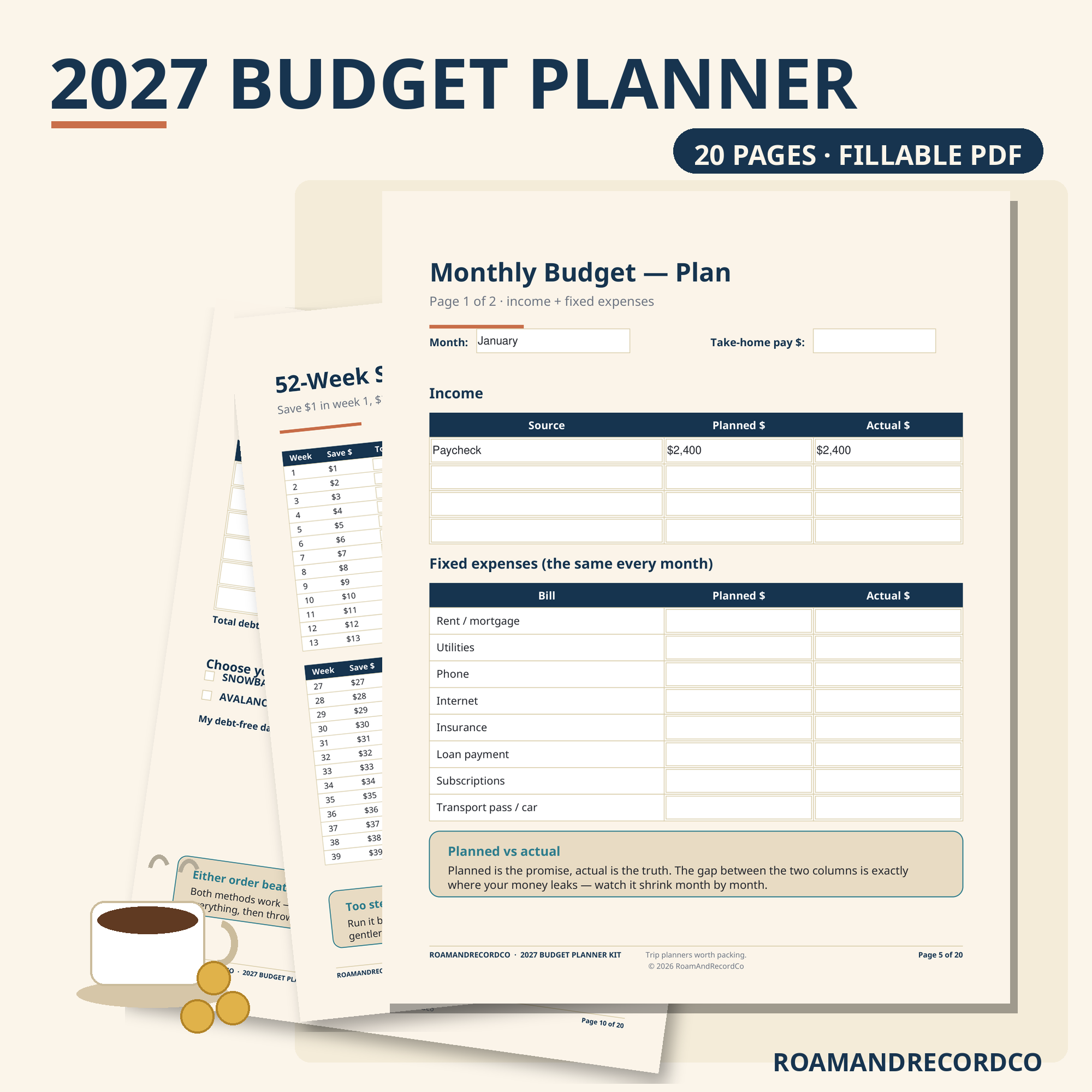
A money resolution lives or dies on tracking, which is why the 2027 Budget Planner exists: twelve months of fillable budget pages where the systems above, the automated transfer, the monthly review, the travel fund, each get their own space. The planner does not save the money for you. It makes the system visible enough that you keep running it.
For debt, list every balance with its interest rate, then pick avalanche or snowball and commit. Avalanche attacks the highest rate first and costs the least in interest. Snowball clears the smallest balance first and delivers the fastest win. The mathematically best method is the one you will actually stick with for twelve months, so choose based on your own psychology and stop second-guessing it in March.
Your 12-Month Resolution Calendar
| Month | Focus |
|---|---|
| January | Install the systems. Automate money transfers, schedule workouts, set up the review ritual date. |
| February | First monthly review. Fix the biggest friction point. Change one thing only. |
| March | Deepen one habit that is working. Leave the struggling ones on maintenance. |
| April | First-quarter money check: total saved versus target, debt balances versus January. |
| May | Spring reset: drop any resolution that no longer matters, upgrade one that does. |
| June | Mid-year review. For each resolution, decide: double down, redesign, or release. |
| July | Protect routines through summer schedule changes. Shrink habits rather than pausing them. |
| August | Second-quarter money check. Adjust automated amounts if income changed. |
| September | Refocus month: one resolution gets extra attention for 30 days. |
| October | Start sketching 2028 direction while this year is still fresh. |
| November | Run holiday spending inside the system: gift budget caps, travel fund withdrawals, no new debt. |
| December | Full-year review. Total the wins, note the lessons, draft next year's systems. |
Notice what the calendar does not contain: a single month where everything changes at once. Change is distributed across the year in small, scheduled doses, which is the only pace humans actually sustain.
When You Fall Off, and You Will
Everyone misses. The trip, the illness, the brutal work month, the week where nothing goes right. The restart protocol has three steps. First, apply never-miss-twice: resume at the very next opportunity, not next Monday, not next month. Second, shrink the habit temporarily: the 20-minute walk becomes a five-minute walk until the rhythm returns. A tiny kept promise rebuilds the identity of someone who does this; a grand abandoned plan rebuilds nothing. Third, run the monthly review early if the fall lasted more than two weeks, and name the friction honestly so the system gets redesigned instead of just restarted.
There is no guilt accounting in this system. Guilt is not a mechanism; it produces avoidance, not action. The only question after a fall is what the system learns. A resolution that survives three falls with redesigns is stronger in October than a perfect January streak ever was, because it has been tested against your actual life.
Frequently Asked Questions
How many New Year resolutions should I set?
What is the monthly review ritual?
Why do money resolutions fail?
When should I start planning my 2027 goals?
2027 Budget Planner
Fillable PDF · Instant download · US Letter + A4 · No app needed.