Every December the same thing happens in households across the country: you buy three gifts for your brother, forget your mother-in-law entirely, and discover on December 23 that the present you were certain you had already bought is nowhere to be found. Gift chaos is not a personality flaw. It is what happens when a dozen people's wishes live in text messages, sticky notes, and your memory at the same time.
A christmas gift list planner fixes this with a boring, reliable system: one master list organized by person, a per-person spending cap decided before you shop, and a simple tracker that follows every gift from bought to wrapped to shipped or delivered. This guide walks through each step with real numbers and a week-by-week countdown, so the budget you set in November is still intact in January.
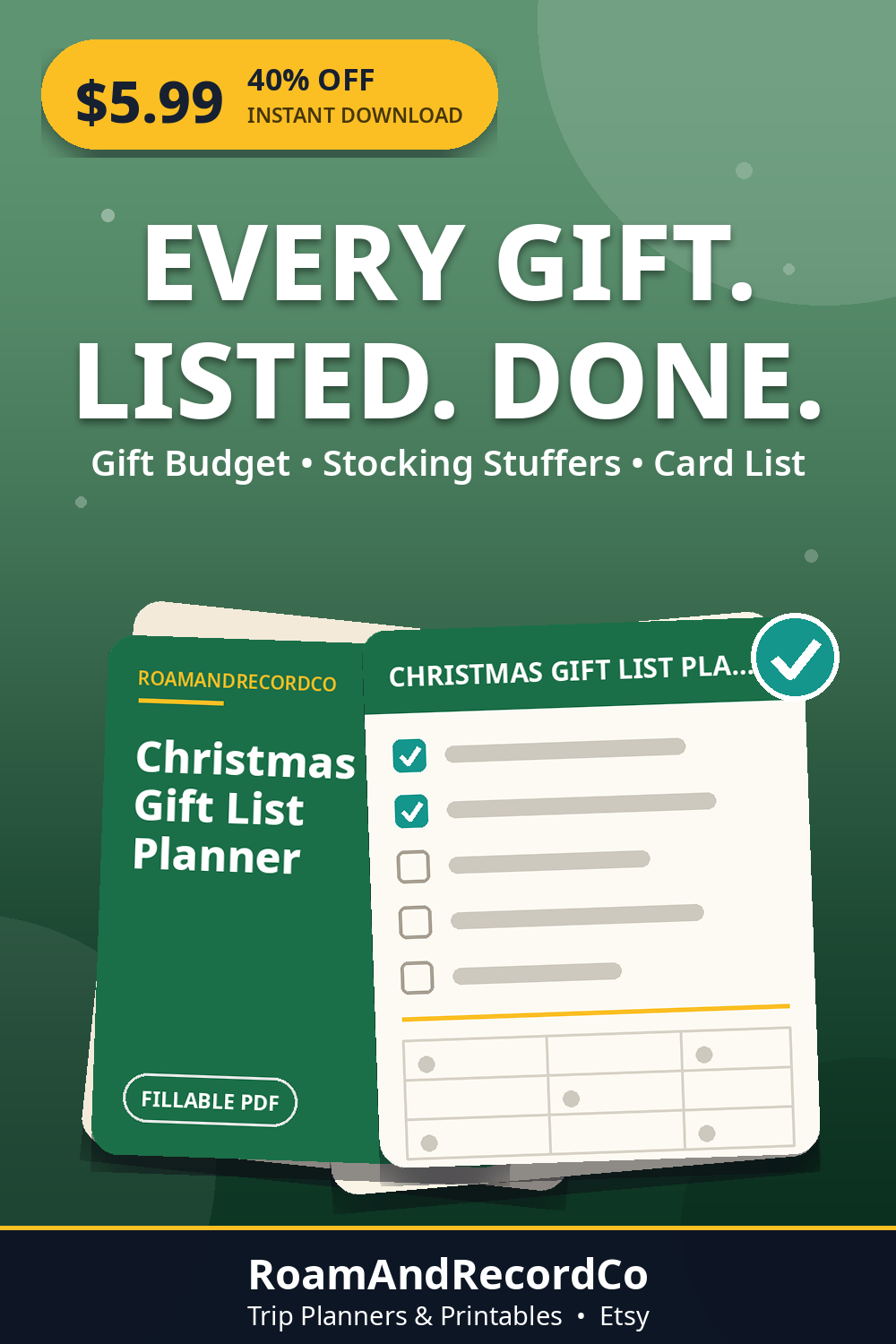
Christmas Gift List Planner
Fillable PDF · Instant download · US Letter + A4 · No app needed.
Why Most Gift Lists Fail
Most gift lists fail for three predictable reasons, and none of them is a lack of generosity. The first is that there is no single written list at all. Gift ideas arrive in fragments: your sister mentions a cookbook in October, your dad points at a tool set in a store in November, a coworker drops a hint at lunch. Each fragment gets stored wherever is convenient in the moment, which means no one place holds the full picture, and December shopping becomes a scavenger hunt through your own memory.
The second reason is the absence of per-person budget caps. Without a cap, spending drifts. A $25 plan for a friend becomes a $48 gift because it was on sale and felt right in the moment. Two or three of those drifts, and the holiday budget is gone before the big family gifts are even purchased. Caps are not about being stingy; they are about deciding the trade-offs on paper in November instead of discovering them on a credit card statement in January.
The third reason is missing tracking. A gift that is bought but not recorded gets bought twice. A gift that is bought but not wrapped becomes a late-night panic on Christmas Eve. A gift that is wrapped but never shipped becomes an awkward January apology. Each of these failures is a tracking failure, and each one is fixed by the same habit: write the status down the moment it changes.
Build Your Master List by Person
Start by writing down every single person you need to buy for before you assign a single dollar. Do this first because the list is almost always longer than it feels in your head. Between immediate family, extended family, kids, friends, coworkers, neighbors, teachers, and service people, most households land somewhere between ten and twenty names once everyone is written out.
Give your list these columns: Person, Group, Budget Cap, Idea 1, Idea 2, Idea 3, Bought, Wrapped, Shipped or Delivered. The three idea columns matter more than they look. When you sit down with the list in November, brainstorming three possibilities per person takes ten minutes and saves you from the December trap of buying the first thing you see because the clock is running.
Group people so the caps make sense together. Immediate family gets the highest caps, then kids, then extended family, then friends, then coworkers and neighbors, then stocking stuffers as their own category. Service people, like a mail carrier or a babysitter, usually get a small fixed amount or a gift card rather than a shopped gift, and they still belong on the list so they are not forgotten. Holiday cards get their own separate list, which we will cover below, because cards have addresses and mailing deadlines that gifts do not.
Set the Total Budget First, Then the Per-Person Caps
Decide the total holiday gift budget before you decide anything else. This is the number everything else hangs from. A workable way to pick it: choose an amount you could pay off in full with your January paycheck without touching savings. For this example, we will use $600, and you can scale every number up or down to fit your own total.
Now divide the total into group budgets, then into per-person caps:
- Immediate family: $260 total. Mom $80, Dad $80, Sister $50, Brother $50.
- Kids: $140 total. Two kids at $70 each.
- Friends: $80 total. Four friends at $20 each.
- Coworkers and neighbors: $40 total. Two people at $20 each.
- Stocking stuffers: $50 total, roughly $10 per stocking across five stockings.
- Cards and postage: $30 total.
Add it up: 260 + 140 + 80 + 40 + 50 + 30 = $600. Every dollar is assigned, and every person has a cap. This is the exact page the Christmas Gift List Planner opens with: a total budget at the top and a row for every person below it, so the math stays visible while you shop.
The rule that makes caps work is the trade rule: a cap can move, but only by trade. If Mom's gift comes to $95, that extra $15 comes from somewhere else on the list, maybe Brother's cap dropping from $50 to $35 with a smaller but thoughtful gift. What never happens is a cap quietly growing with no offset, because three quiet growths are how $600 becomes $800.
Track Every Gift From Bought to Wrapped to Shipped
Each gift moves through three statuses, and your list should show all three. Bought means the item is in your possession or ordered, with the receipt saved. Mark it the same day you buy it, not at the end of the week, because same-day marking is the habit that prevents duplicate purchases. If you ordered online, write the order number next to the row so you can find it again.
Wrapped means the gift is fully finished: wrapped, tagged with the recipient's name, and placed wherever finished gifts live in your house. Wrapping in batches works far better than wrapping one gift at a time. Pick two wrapping sessions, one in early December and one in mid-December, put on a movie, and clear the backlog. Tag every gift as you wrap it. An untagged wrapped gift in a pile of wrapped gifts is a mystery you will have to solve by shaking.
Shipped or delivered is the final status. For gifts traveling by mail, ship ground packages a full two weeks before Christmas to leave room for carrier delays, which puts the shipping deadline for Christmas 2026 around December 11. Keep the tracking number in the gift's row until the package shows as delivered. For hand-delivered gifts, note the event where you will give it: the family dinner, the office party, the school concert. A gift with a planned handoff does not get left on the kitchen counter.
Stocking Stuffers Under $25 That Don't Feel Like Fillers
Stockings go wrong in two directions: either they become an afterthought of candy and filler, or they quietly cost as much as a main gift. The fix is a per-stocking cap, $25 is a solid one, and a target of five to seven small items per stocking. Small items feel generous in a stocking because unwrapping six things beats unwrapping two, even when the total is the same.
Concrete ideas that stay under the cap:
- A genuinely good chocolate bar, $4 to $6, not the holiday-aisle multipack.
- A lip balm trio in seasonal flavors, about $9.
- Warm, thick socks in a fun pattern, $10 to $14.
- A small flashlight or a pocket multi-tool, $10 to $15.
- A tea or hot chocolate sampler, around $12.
- A pocket card game, about $10.
- A travel-size candle in a winter scent, around $14.
- A phone stand or grip, about $12.
- A 300-piece mini puzzle, around $9.
- A nice hand cream and lip mask set, about $12.
Shop stocking stuffers in one trip, online or in one store, with the per-stocking cap written at the top of the list. Count items per stocking as you go: five items averaging $5 beats one $25 item sitting alone in a stocking every time.
Don't Forget the Holiday Card List
Cards need their own list because they have logistics that gifts do not: addresses, postage, and a mailing deadline. Set up four columns: Name, Address Confirmed, Card Ready, Mailed. The address column is the one people skip, and it is the one that causes the most December scrambling, so confirm addresses in November with a quick text to anyone you have not mailed in the last year. People move more often than you think.
If you send photo cards, order them in the first week of December at the latest. Printers and photo services get slammed in mid-December, and rush shipping on cards is money better spent on gifts. For standard cards, buy a few more than your list needs; five extra cards cover the neighbor you forgot and the card you smudge while signing.
Mail domestic cards by December 15 so they arrive before Christmas through normal first-class mail. International cards need another full week on top of that. Keep a small stack of stamps with the cards themselves, not in a drawer across the house, so signing and stamping happens in one sitting instead of three.
Your Week-by-Week Countdown to December 25
Early November: Write every name on the master list. Set the total budget. Assign per-person caps. Brainstorm three gift ideas per person. Confirm card addresses.
Mid-November: Buy non-perishable staples and stocking stuffers. Order anything personalized or engraved now, since custom items carry two to three week lead times. Start the card list.
Thanksgiving week (Thanksgiving is November 26, 2026): Finish big-ticket purchases while sales are active, and compare prices before you buy rather than after. Do the first wrapping session for anything already bought.
First week of December: Wrap in batches and tag everything. Ship ground packages by around December 11. Order photo cards if you have not yet.
Mid-December: Mail holiday cards by December 15. Check tracking numbers on shipped gifts and confirm deliveries. Do the second wrapping session.
December 20 to 23: Local pickups and last in-store purchases only. No more shipping. Assemble stockings on Christmas Eve with the per-stocking counts from your list.
Work this countdown once, and next year it gets easier: the names, the caps, and the timing are already decided, and December becomes shopping and wrapping instead of planning and panicking.
Frequently Asked Questions
How much should I spend on Christmas gifts in total?
When should I start my Christmas gift list?
How do I avoid buying the same gift twice?
What if I blow one person's budget cap?
Christmas Gift List Planner
Fillable PDF · Instant download · US Letter + A4 · No app needed.