Your first cruise is unlike any other kind of trip. The hotel, the restaurants, the entertainment, and the transportation are all the same floating building — which sounds simple until you realize you need to understand cabins, dining assignments, drink packages, embarkation windows, and shore excursions before you ever leave home. First-timers who do a little homework have dramatically better sailings than those who wing it.
This guide covers what actually matters for a first cruise: how to choose the ship and sailing, where your cabin should be, what the fare really includes, whether the drink package is worth it, and how embarkation day works. No jargon, no assumptions — just the practical knowledge that turns a confusing first sailing into a great one.
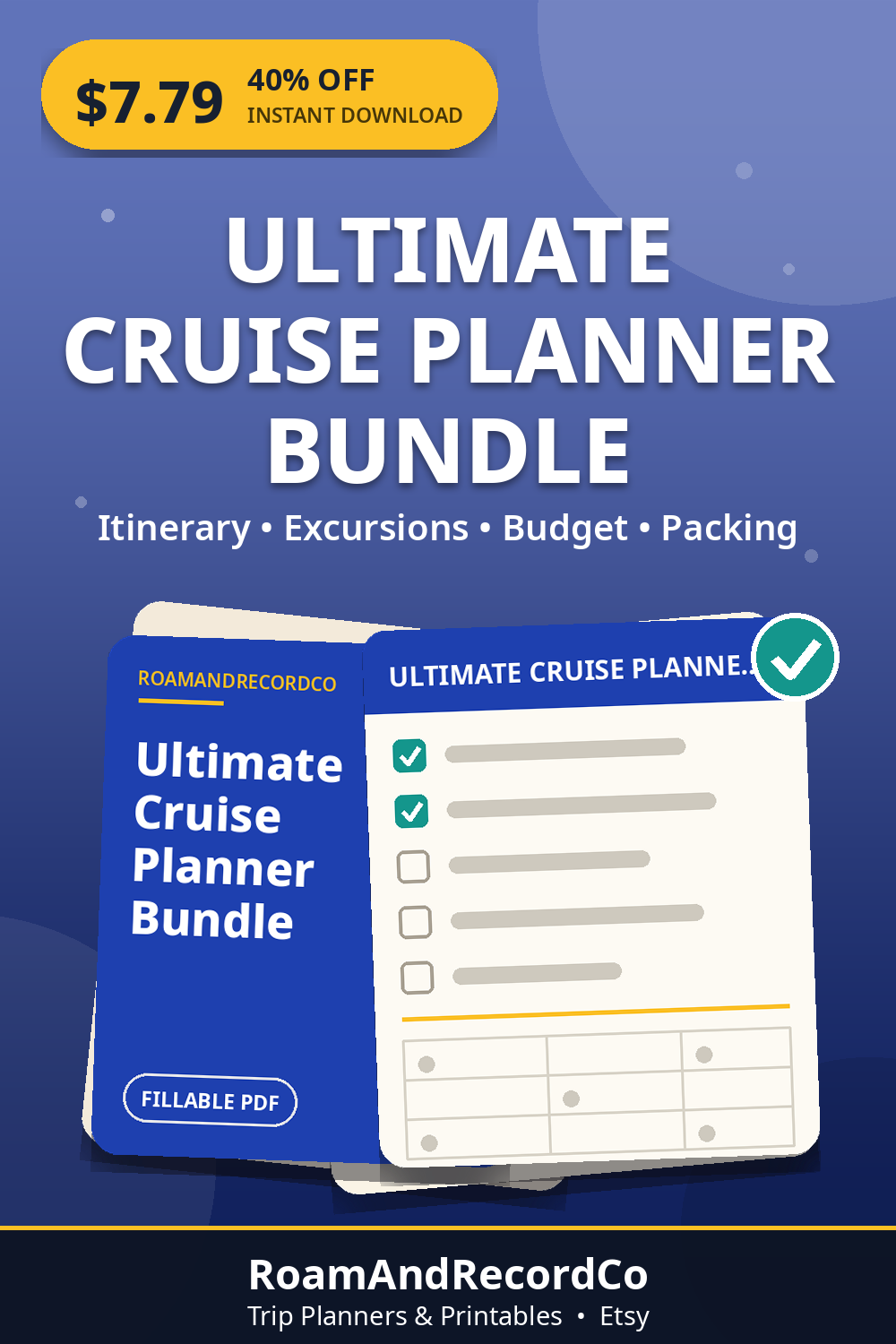
Ultimate Cruise Planner Bundle
Fillable PDF · Instant download · US Letter + A4 · No app needed.
Choose the Ship Before the Itinerary
First-timers usually pick a cruise by destination. Flip that: pick the ship first, the itinerary second. On a seven-day sailing you spend four or five full days on the ship itself — sea days, evenings, mornings in port before excursions. The ship's size, age, and vibe shape your week more than any single port.
Big new ships (4,000+ passengers) are floating resorts: waterslides, a dozen restaurants, Broadway-style shows, constant activity. They are ideal if you want variety and energy, and they handle first-timers well because there is always something to do. Smaller, older ships (1,500–2,500 passengers) are calmer, easier to navigate, and often cheaper — better if you want a relaxed week and do not need a go-kart track.
For a first cruise, the mainstream lines' 7-night Caribbean or Bahamas sailings are the classic starting point for good reasons: frequent departures, competitive pricing, warm weather, and ports built for cruise visitors. A 4- or 5-night sailing is an even gentler first test — long enough to learn the ropes, short enough that a ship you do not love is only a few days.
Choosing a Cabin: Location Matters More Than Size
Cabin category gets all the attention; cabin location deserves it. Three rules cover most of the decision:
Midship and lower decks move the least. If you are prone to motion sickness, book a cabin midship (the middle third of the vessel) on a lower passenger deck. The ends of the ship — especially forward — feel every wave. Higher decks amplify motion too. An inside cabin midship on deck 5 will ride calmer than a balcony suite at the front of deck 12.
Avoid noise neighbors. Cabins directly below the pool deck get early-morning chair-dragging; cabins near nightclubs, theaters, or the atrium get late-night sound. Cabins at the very front or back near anchor machinery can be noisy during early-morning port arrivals. When booking, pull up a deck plan and check what is above, below, and beside your cabin — five minutes of map-reading prevents a week of regret.
Pick the category that matches your habits. Inside cabins are dark, quiet, and cheap — great sleepers love them. Oceanview adds a window and natural light. Balconies add private outdoor space you will actually use on scenic sailings (Alaska, Norway, the Mediterranean) and less on port-heavy Caribbean weeks where you are off the ship all day. Suites add space and perks at a steep premium. For a first cruise, an oceanview or a modest balcony midship is the sweet spot: comfortable without the suite price.
Book early for the best cabin choice — the well-located midship cabins sell first. And consider the guarantee option only if you are flexible: the line picks your cabin, often at a discount, but you could land under the basketball court.
What the Fare Includes (and What It Does Not)
The base fare covers more than first-timers expect — and the extras add up faster than they expect. Know the split before you board.
| Typically Included | Typically Extra |
|---|---|
| Main dining room meals | Specialty restaurants ($30–$60+ per person) |
| Buffet and casual venues | Alcoholic drinks and sodas |
| Pools, hot tubs, fitness center | Spa treatments |
| Broadway-style shows, live music, comedy | Shore excursions ($50–$200+ per person) |
| Kids' and teens' clubs | Wi-Fi packages |
| 24-hour room service (continental) | Photos, arcade, casino |
| Daily gratuities ($16–$20 per person per day) |
The big three budget surprises for first-timers: gratuities (a couple pays $225–$280 in automatic gratuities on a 7-night sailing), drinks, and shore excursions. A family of four can easily add $1,500 to $2,500 in onboard spending to a fare that looked all-inclusive. None of this is a trick — it is just how cruise pricing works. Plan for it and the final bill holds no surprises.
Drink Package Math
The drink package is the most debated purchase in cruising, and the answer is pure arithmetic. A standard cruise-line beverage package costs roughly $60 to $100 per person per day, plus an automatic 18% gratuity on the package price. At $80 a day plus gratuity, you are paying about $95 a day for the privilege.
Individual drink prices: cocktails $12–$15, wine by the glass $10–$14, beer $7–$9, soda $3–$4, specialty coffee $4–$6. To break even on a $95-a-day package, you need roughly 6–7 cocktails, or a mix like 4 cocktails plus 3 sodas and 2 coffees, every single day of the sailing.
Buy the package if: you drink 6+ alcoholic drinks daily, you are on a sea-day-heavy itinerary, or you simply want to stop thinking about prices. Skip it if: you drink 1–3 drinks a day, you are in port most days (where you will drink ashore), or you are happy with the free options — water, basic coffee and tea, lemonade, and some juices are included in the fare. Note the fine print: on most lines, if one adult in the cabin buys the package, all adults in the cabin must buy it too.
There is a middle path many first-timers miss: the soda or coffee package ($10–$15 a day) for the non-drinkers and light drinkers, paying a la carte for the occasional cocktail. Run your own numbers honestly before you buy.
Embarkation Day: What Really Happens
Embarkation day has a rhythm, and knowing it removes all the anxiety. About a week before sailing (the window varies by line), you complete online check-in: passports, emergency contacts, a credit card for onboard expenses, and your arrival time selection. You receive a boarding pass — on some lines called a SetSail pass — on your phone.
Arrive at the port inside your assigned arrival window, not hours early. Early arrivals wait in long lines; on-time arrivals walk through. The sequence: drop checked bags with the porters (keep a day bag with medications, documents, swimwear, and a change of clothes — cabins are usually ready around 1:00–2:00 PM), pass through security similar to airport screening, check in at the counter, and board.
Head straight to lunch — the buffet is open and gloriously uncrowded while everyone else is still in line. Explore the ship in the afternoon: find your cabin, locate your dining room, walk the pool deck. Before sail-away you must complete the muster drill, the mandatory safety briefing; on most lines it is now a quick e-muster on your phone plus a visit to your assembly station. Then find a deck spot for sail-away. You are on vacation.
Sea Days vs. Port Days
Plan sea days and port days differently — they are different kinds of days.
Sea days are for the ship. Sleep in, have a long breakfast, try the activities you skipped while rushing to excursions: the cooking demo, the trivia, the waterslide with no line at 9:00 AM. Book spa treatments on port days, not sea days — port-day spa discounts are common because everyone else is ashore, and sea-day slots fill first.
Port days are for the destination. Decide in advance for each port: ship excursion, independent plan, or stay on the ship. Ship excursions cost more but the ship waits if they run late — an independent tour that returns late means watching your ship sail without you, which happens to passengers every week. If you go independent, be back at least 90 minutes before all-aboard time, not 30.
And know this: you do not have to get off at every port. Staying on the ship on one port day — empty pools, no lines, quiet decks — is a beloved veteran move and a perfectly good use of a first cruise too.
First-Timer Mistakes to Avoid
Flying in the morning of the cruise. One delayed flight and you miss the ship. Fly in the day before, stay near the port, and board relaxed. Travel insurance covers the hotel; it does not cover the heartbreak.
Overpacking formal wear. Mainstream lines have relaxed dress codes; most now run one optional formal night at most. One nice outfit suffices — the tuxedo crowd is largely gone.
Ignoring the daily planner. The ship's daily schedule — activities, show times, dining hours — is your itinerary. Read it each evening. First-timers who never read it miss half the ship.
Booking every excursion through the ship without comparing. Independent operators in most ports offer similar tours for 30–50% less. Compare, read recent reviews, and weigh the savings against the ship-wait guarantee.
If you want all of this — cabin notes, budget worksheets, embarkation checklists, port-day planners — organized in one printable place, the Ultimate Cruise Planner Bundle was built for exactly this first sailing.
What to Pack Specifically for a Cruise
Beyond normal trip packing, cruises have a few specific needs: a small power strip or multi-USB charger (cabins famously have two outlets), magnetic hooks (cabin walls are metal — veterans hang everything on them), motion sickness remedy even if you never get seasick, a refillable water bottle, formal-night outfit, swimwear in your day bag on embarkation day, and a lanyard or card holder for your key card, which is also your onboard ID and charge card.
Frequently Asked Questions
What is the best first cruise to take?
Which cabin is best for motion sickness?
How much are cruise gratuities?
Do I need formal clothes for dinner?
Ultimate Cruise Planner Bundle
Fillable PDF · Instant download · US Letter + A4 · No app needed.