Most itinerary templates fail in one of two ways: they are so vague they are useless, or so rigid they fall apart the moment a flight is delayed. A good template is neither a blank page nor a minute-by-minute prison. It is a working document that holds your plan, your logistics, and your backup options in one place — and it still makes sense when you are tired, jet-lagged, and standing in an unfamiliar train station.
This guide breaks down what a genuinely useful day-by-day template includes, shows you each section with a fully filled sample day, and explains how to use the thing while you are actually traveling. Whether you build yours on paper or print it from a planner, the structure below works for trips from three days to three weeks.
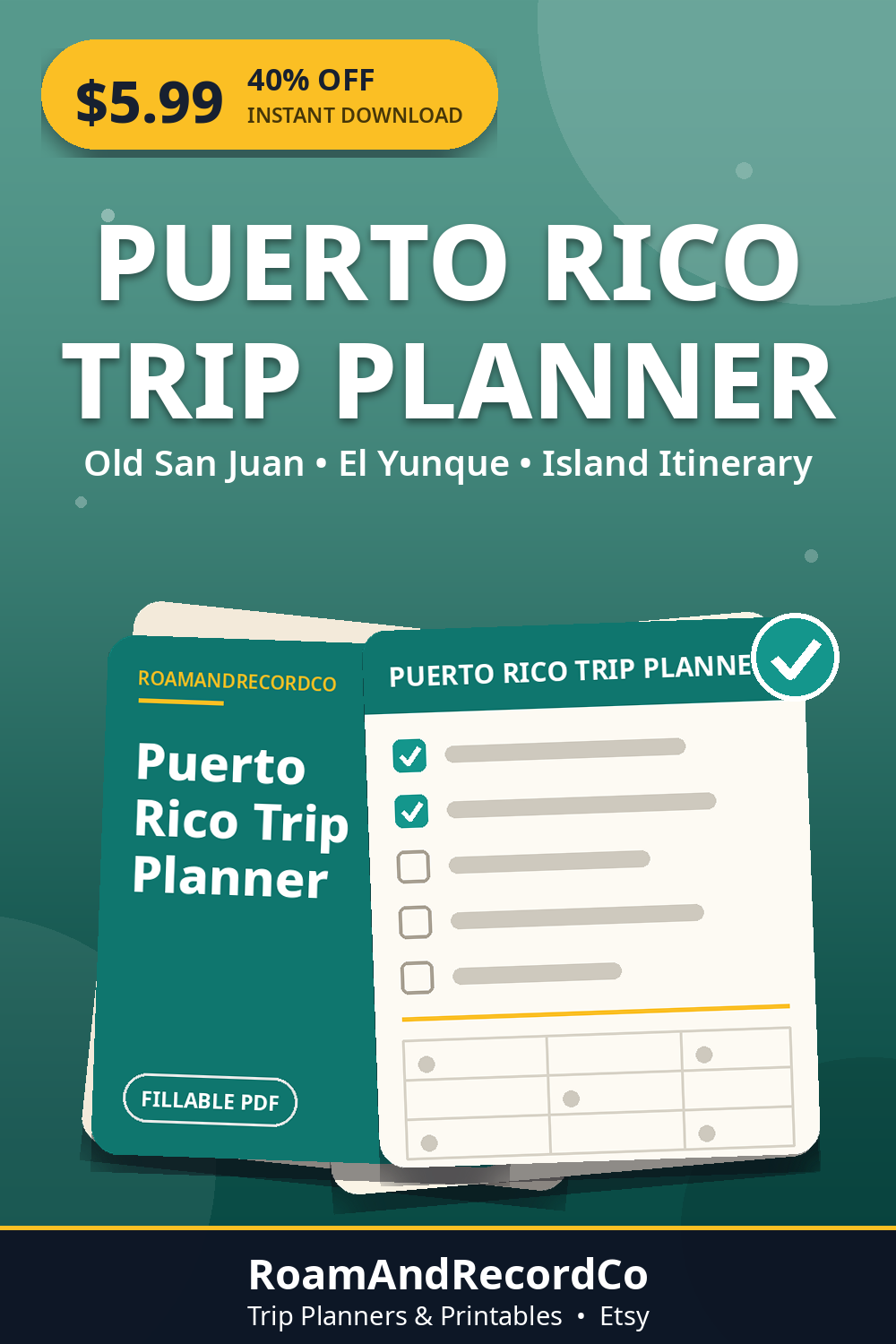
Puerto Rico Trip Planner
Fillable PDF · Instant download · US Letter + A4 · No app needed.
The Five Parts of a Good Template
Every complete trip template has the same five parts, in this order. If your template is missing any of them, you will feel it mid-trip.
1. Trip overview. One page with the trip's vital facts: dates, destination, travelers, budget ceiling, and your three to five non-negotiables. This is the page you read on the plane to remind yourself what the trip is actually about.
2. Daily pages. One page (or spread) per day with time blocks, anchors, meals, and logistics. This is where you live during the trip.
3. Confirmations and numbers. Every booking reference, address, phone number, and check-in time in a single table. When something goes wrong, this is the page you need in under ten seconds.
4. Budget tracker. Planned versus actual spending, tracked daily. Catches budget drift while there is still trip left to adjust.
5. Notes and backups. Rain plans, plan-B options, packing notes, and anything you learn along the way. The section everyone skips and everyone needs.
The Trip Overview Page
Your overview page answers five questions at a glance: where, when, who, how much, and what matters most. Fill it in before you book anything else, because it becomes your decision filter.
Include the destination and dates, the full names of everyone traveling, and the total budget ceiling you agreed on — not a per-day target, the whole-trip number. List your non-negotiables: the two or three experiences the trip must include. Add one line for the trip's pace (relaxed, balanced, or packed), because two travelers with different pace expectations will fight about the daily pages unless they agreed on the pace first.
Finally, add emergency information: your travel insurance policy number and 24-hour assistance line, the contact details of someone at home who has your itinerary, and any critical medical notes (allergies, prescriptions) for the group. If someone in your party has a medical emergency abroad, this page is what a travel companion hands to the hospital staff.
Daily Pages: The Two-Block Layout
Each daily page follows the same layout so you can read any day at a glance, even half-asleep. The structure:
- Date and day number at the top (Day 3 of 7), plus the overnight location — essential on trips with multiple bases.
- Morning block (roughly 9:00 AM–12:00 PM): one anchor activity, its address, booking time, and cost.
- Lunch: a planned spot or a neighborhood to wander, with one backup option.
- Afternoon block (roughly 2:00–5:00 PM): one anchor activity with the same details.
- Evening: intentionally light — a dinner idea, a sunset spot, or nothing at all.
- Logistics strip: transit between anchors, confirmation numbers needed that day, and what to bring (tickets, swim gear, hiking boots).
- Backup plan: one sentence — what you do if the anchor falls through.
Leave white space on every daily page. You will use it for the things you discover: the cafe a local recommends, the viewpoint that deserves a return visit, the actual cost of the taxi. A template with no room for reality becomes a document you stop using by day three.
A Fully Filled Sample Day
Here is what a completed daily page looks like, for day four of a week in Lisbon, Portugal:
Day 4 of 7 — Thursday, June 12 — Overnight: Lisbon (Alfama apartment)
Morning block, 9:30 AM–12:30 PM: Tram 28 to Graca, then walk down through Alfama to the Castelo de Sao Jorge. Castle entry pre-booked for 10:00 AM, confirmation LX-88412, 15 euros per person. Bring: camera, water, comfortable shoes — the castle hill is steep cobblestone.
Lunch: Tasca do Zé in Alfama for grilled sardines (cash preferred). Backup: any tasca on Rua dos Remédios — they are all good and none take reservations.
Afternoon block, 2:30–5:00 PM: Tile Museum (Museu Nacional do Azulejo). Metro to Santa Apolonia, then a 15-minute walk. Entry 8 euros, no booking needed on weekdays. The convent church inside is the real highlight — allow a full two hours.
Evening: Miradouro da Graca for sunset, then dinner wherever looks busy near the apartment. No plan — this is the wandering night.
Logistics: Day transit pass 6.60 euros covers tram and metro. Castle confirmation needed at the gate. Total planned spend: about 40 euros per person.
Backup plan: If it rains, swap the castle for the Calouste Gulbenkian Museum (indoor, 10 euros) and move the castle to Saturday morning.
Notice how the day is specific without being rigid. Times are approximate, every anchor has an address and a cost, and the backup plan means rain does not ruin the day — it just rearranges it.
Confirmations and Numbers Page
One table, every booking, no exceptions. Columns: what it is, confirmation or reference number, date and time, total cost, and a contact phone number or email. Fill it in the moment you book, not the night before you leave.
| Booking | Confirmation # | Date/Time | Cost | Contact |
|---|---|---|---|---|
| Outbound flight | AA-7X2K9P | Jun 9, 8:15 AM | $412 | Airline app |
| Alfama apartment | AB-559021 | Jun 9–16 | $980 | Host via app |
| Castle entry | LX-88412 | Jun 12, 10:00 AM | 30 euros | Venue website |
| Return flight | AA-7X2K9P | Jun 16, 11:40 AM | (included) | Airline app |
| Travel insurance | POL-2026-4471 | Jun 9–16 | $68 | 24-hr line saved |
Print this page or save it offline. Airport Wi-Fi fails, phones die, and roaming does not always work the moment you land. The confirmations page is the single most valuable piece of paper on your trip.
The Budget Tracker Block
A template without a budget tracker is a wish list. Track two numbers per day: planned spend and actual spend. Planned comes from your daily pages; actual gets filled in each evening in about ninety seconds.
Set up categories before the trip: lodging (usually prepaid), transport, food, activities, shopping, and a miscellaneous buffer of 10 to 15 percent. The buffer is not optional — every trip has surprise costs, from the taxi you did not expect to the excursion that was too good to skip.
The tracker's real job is early warning. If you are 20 percent over budget by day three of seven, you adjust days four through seven — cheaper lunches, one fewer paid attraction — while it is still easy. Travelers who do not track discover the overrun at the airport on the way home, when it is a regret instead of a decision.
Backup Plans: The Section Everyone Skips
For each day with an outdoor anchor or a must-do booking, write one backup sentence on the daily page. Rain plan, closure plan, sold-out plan. It takes thirty seconds per day during planning and saves hours of disappointed scrolling through your phone when plan A collapses.
Also keep a short list of plan-B experiences for the destination as a whole: two indoor attractions, one great food experience, one neighborhood worth wandering in any weather. When the group is tired and cranky and the original plan just died, nobody wants to research. They want one person to say, "We are going here instead," and mean it.
How to Use Your Template While Traveling
A template only works if you actually open it. Each morning, spend five minutes reviewing the day's page over coffee: check the weather, confirm the anchor still makes sense, note anything that needs booking or confirming. Each evening, spend two minutes logging actual spend and jotting notes for the next day.
Keep the template accessible offline — a printed copy in your daypack beats a perfect app that needs signal. And give one copy (or photo set) to your emergency contact at home. If they ever need to find you or help you, the overview page and daily pages tell them exactly where you are supposed to be.
If you would rather start from a finished structure than build these pages from scratch, the Puerto Rico Trip Planner has the day blocks, confirmation tables, and budget pages laid out and ready to fill in.
Common Template Mistakes
Planning every hour. A template with 8:00, 8:30, 9:00 slots looks organized and behaves like a trap. Plan blocks, not hours.
No confirmation numbers. Writing "hotel booked" without the reference number means a 20-minute search at every check-in. The number goes on the page the moment you book.
Skipping the budget tracker. The tracker is the difference between a plan and a fantasy. Ninety seconds a night keeps the whole trip honest.
One copy, on one phone. Phones get lost, stolen, and drowned. Print the overview and confirmations pages, or at minimum email them to yourself and your travel companion.
Frequently Asked Questions
How much space should each day get in the template?
Should I print my itinerary or keep it digital?
How often should I update the budget tracker?
Can I reuse the same template for different trips?
Puerto Rico Trip Planner
Fillable PDF · Instant download · US Letter + A4 · No app needed.